Introduction to Optimization
CO 250
Lecture 3
Kevin Shu
Lecture Outline
- Integer programming review
- Graph Problems
Integer Linear Programming Review
Integer Linear Programming Review
An integer linear program is an optimization problem of the form
| min | $c^{\intercal}x$ |
| such that | $Ax \le b$ |
| $x \in \Z^n$ |
Some variables can be allowed to be continuous.
The min can be a max. The inequalities can go the other way. Equalities are also allowed.
ILP Examples
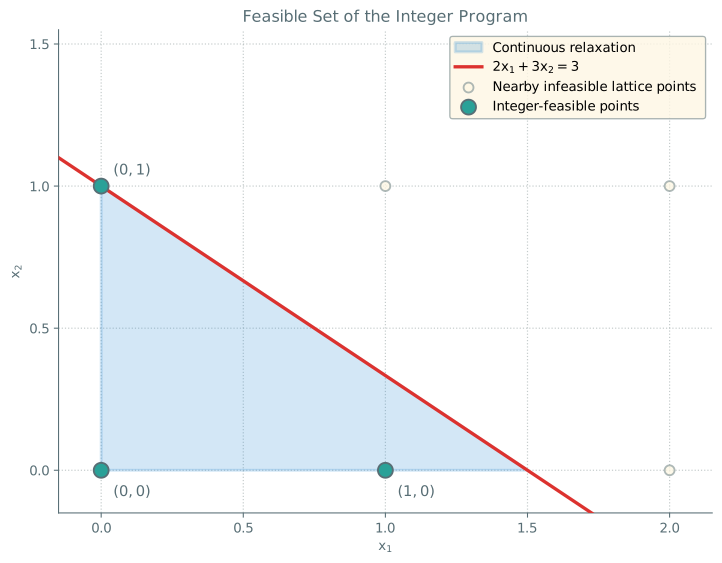
| min | $x_1$ |
| such that | $2x_1 + 3x_2 \le 3$ |
| $x_1, x_2 \ge 0$ | |
| $x \in \Z^2$ |
ILP Examples
Cookie Assembly
We have a number of cookies that we need to bake. We want to put all of the cookies on a baking sheet without overlapping.
For simplicity, we will imagine that each cookie is a rectangle (though we can model other shapes easily).
We will also want to discretize each rectangle, so that they are composed of small square `pixels'.
ILP Examples
Cookie Assembly Setup
We are given $K$ cookie sheets, each one of size $\ell \times w$.
We also have $B$ cookies, and cookie $i$ is a rectangle of size $a_i \times b_i$.
Each cookie has a number of places it can be located; we need to choose such a location for each cookie, and cookies cannot overlap.
ILP Examples
Cookie Assembly Decision Variables
First, we decide whether to use each cookie sheet.
Let $y_k$ be a variable that is 1 if cookie sheet $k$ is used, and 0 otherwise, for $k = 1,\dots, K$.
ILP Examples
Cookie Assembly Decision Variables
Second, we decide where each cookie goes.
ILP Examples
Cookie Assembly Decision Variables
Cookie $i$ can be located on many different places.
ILP Examples
Cookie Assembly Constraints
We must put each cookie in exactly one location, so for each $i \le B$ \[ \sum_{k=1}^K \sum_{r = 1}^{\ell - a_i + 1}\sum_{c = 1}^{w - b_i + 1} x_{ikrc} = 1. \]
ILP Examples
Cookie Assembly Constraints
We can only place one cookie in each cell of a sheet, and we can only put a cookie at that location if that sheet is used.
So for each $k = 1, \dots, K$, each $r = 1,\dots,\ell$, and each $c = 1,\dots,w$, \[ \sum_{i=1}^B \sum_{r' = r-a_i+1}^{r}\sum_{c' = c-b_i+1}^{c} x_{ikr'c'} \le y_k. \]
Notice how this ties the placement variables back to $y_k$: a cell can only be filled on a sheet we actually use.
ILP Examples
Cookie Assembly Decision Constraints
The objective here is simple; we want to use as few cookie sheets as possible, which is given by $\sum_{k=1}^K y_k$.
Assembling
| min | $\sum_{k=1}^K y_k$ | |
| such that | $ \sum_{k=1}^K \sum_{r = 1}^{\ell - a_i + 1}\sum_{c = 1}^{w - b_i + 1} x_{ikrc} = 1 $ | for $i=1,\dots,B$ |
| $ \sum_{i=1}^B \sum_{r' = r-a_i+1}^{r}\sum_{c' = c-b_i+1}^{c} x_{ikr'c'} \le y_k $ | for each $k =1,\dots,K$ | |
| for each $r =1,\dots,\ell$ and $c = 1,\dots,w$ | ||
| $0 \le x_{ikrc} \le 1$ | ||
| $0 \le y_k \le 1$ | ||
| $x_{ikrc}, y_k \in \Z$ |
Packing Problems More Generally
What if the cookies here are not rectangles, but rather circles? What if we allow rotations?
It will be very complicated to keep track of all of the variables!
We would need a way to organize these constraints in a neater way, so that we can more easily describe the problem.
Packing Problems Revisited
Abstractly, for each cookie, there is a set of configurations for that cookie.
The configurations for each cookie are not independent; we must ensure they don't overlap!
Two configurations are compatible as long as they don't overlap. If I have a collection of configurations for each cookie, then as long as each pair is compatible, the collection of configurations is compatible.
We want a way to record all of the possible configurations, and which pairs overlap, and then choose a configuration so that every pair is compatible.
Graphs
Graphs
A graph $G = (V,E)$ consists of a set of `vertices' $V$ and a set of `edges' $E$.
Formally, an edge is an unordered pair $\{i,j\}$, where $i$ and $j$ are in the vertex set.
Graphs can be visualized as a picture where the vertices are points, and the edges are lines.
Graph Examples
The Cycle $C_6$
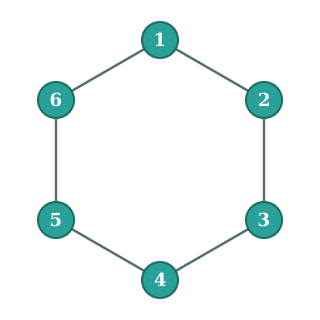
The cycle $C_n$ has $n$ vertices arranged in a ring, each joined to its two neighbours.
We can think of every vertex as labelled by an integer so that $V = \{1,2,3,4,5,6\}$, and we have edges \[E = \{\{1,2\}, \{2,3\},\{3,4\},\{4,5\},\{5,6\},\{1,6\}\}\]
Graph Examples
The Complete Graph $K_5$
In the complete graph $K_n$, every pair of distinct vertices is joined by an edge.

Graph Examples
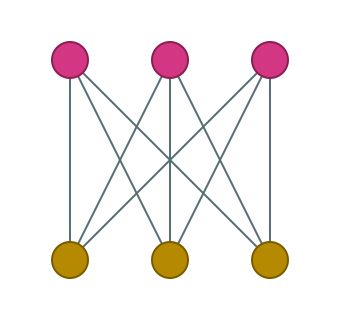
The Complete Bipartite Graph $K_{3,3}$
In a bipartite graph the vertices split into two groups, with edges only going between the groups.
Graph Examples
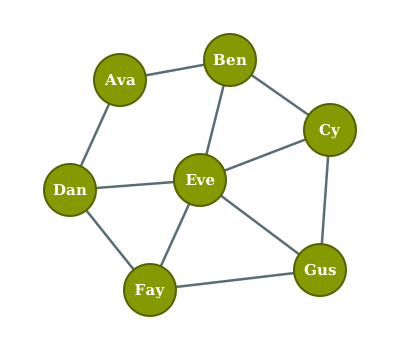
A Social Network
Let each person be a vertex, and join two people by an edge whenever they are friends.
Graph Examples
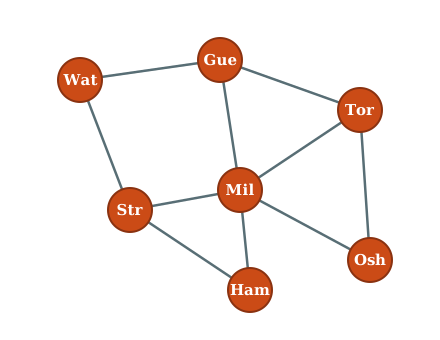
A Road Network
Let each city be a vertex, and join two cities by an edge when there is a direct road between them.
Graph Problems
Graph Problems
A graph problem is an algorithmic problem that takes in as input a graph (given as a list of vertices and edges).
Many of these problems can be written as integer programs. We will look at two in detail: the clique problem and the matching problem.
Cliques
The Clique Problem
Let $G = (V, E)$ be a graph. A set of vertices $S \subseteq V$ is a clique if every pair of vertices in $S$ is joined by an edge.
In other words, the vertices in $S$ are pairwise adjacent: every two vertices you pick are connected by an edge.
The maximum clique problem asks for a clique with as many vertices as possible.
The Clique Problem
An Example
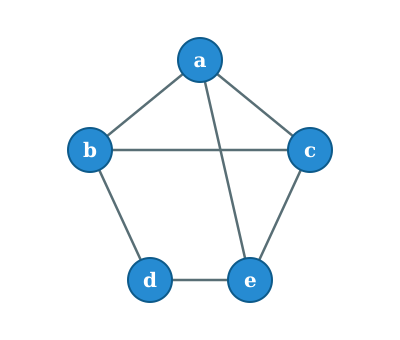
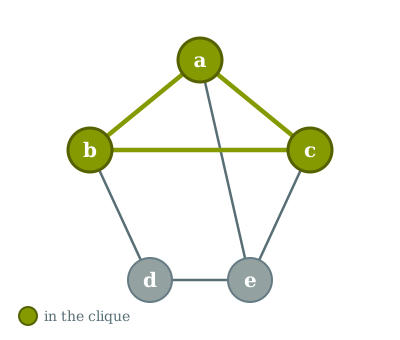
The green vertices $\{a, b, c\}$ form a clique: all three edges $ab$, $ac$, and $bc$ are present.
We could not add $d$, since $d$ is not adjacent to $a$ or $c$.
Is $\{a, b, c\}$ the largest possible? No four vertices are pairwise adjacent here, so this is a maximum clique of size $3$.
The Clique Problem
Some Familiar Graphs
In the complete graph $K_n$, every pair of distinct vertices is joined by an edge.
The maximum clique then consists of all of the vertices in the graph.
The Clique Problem
Some Familiar Graphs
In the cycle $C_n$, every edge forms a clique, but no set of 3 vertices form a clique.
The maximum clique then consists of any edge.
The Clique Problem
Example: Packing Cookies
Suppose that we only have one baking sheet, and we want to pack as many cookies as we can into the sheet.
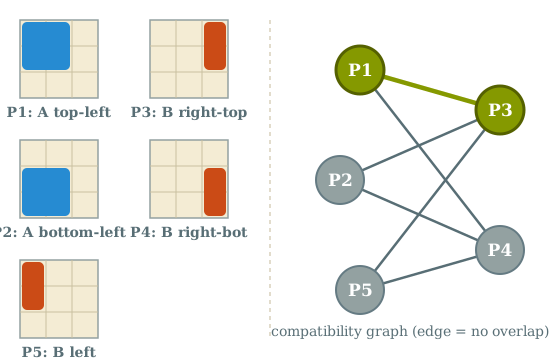
We can turn this into a clique problem using a compatibility graph.
Each cookie configuration is a vertex. Two configurations are joined by an edge if they don't overlap.
The Clique Problem
Example: Packing Cookies
Consider a $3 \times 3$ tray with a big cookie $A$ ($2 \times 2$) and a finger cookie $B$ ($1 \times 2$). Here are five candidate placements.
The Clique Problem
Cliques = Valid Configurations
A clique consists of a list of cookie configurations where no pair overlaps.
A valid cookie configuration is exactly a clique of the compatibility graph, and packing as many cookies as possible is finding a maximum clique.
The Clique Problem
ILP Formulation for Cliques
A clique is a collection of vertices in a graph so that every pair of vertices is connected by edge.
Can we represent the clique problem with an ILP?
What are the decisions? What are the constraints?
The Clique Problem
ILP Formulation for Cliques
Decisions are which vertices are in the graph. Make an indicator variable $x_i$ for each $i \in V$.
Constraints require that if $x_i$ and $x_j$ are both 1, then they are joined by an edge. For all $i,j \in V$ so that $\{i,j\} \not \in E$, \[ x_i + x_j \le 1. \]
The Clique Problem
ILP Formulation for Cliques
Objective is the number of vertices in the clique: $\sum_{i \in V} x_i.$
| max | $\sum_{i \in V}x_i$ |
| such that | $x_i + x_j \le 1$ for any $\{i,j\} \not \in E$. |
| $0 \le x_{i} \le 1$ | |
| $x_{i} \in \Z$ |
Bipartite Matching
Bipartite Matching
Food Preparation
There are $N$ people at a party, and $N$ meals have been prepared.
Each person has some meals that they might want, and others they don't.
Given the information about people's food preferences, how can we determine if there is a way of giving everyone a meal they want?
Bipartite Matching
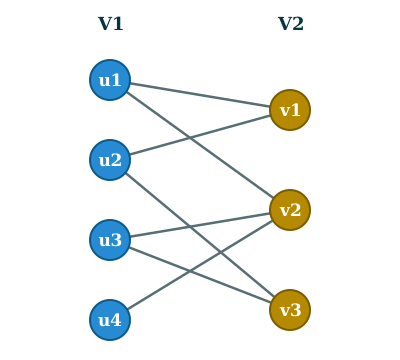
A bipartite graph is a graph whose vertex set can be divided into two disjoint parts $V = V_1 \cup V_2$ with $V_1 \cap V_2 = \varnothing$, and every edge $e \in E$ consists of one element from $V_1$ and one element from $V_2$.
Bipartite Matching
A matching in a bipartite graph is a collection of edges in that graph so that no two edges in the collection share a vertex.
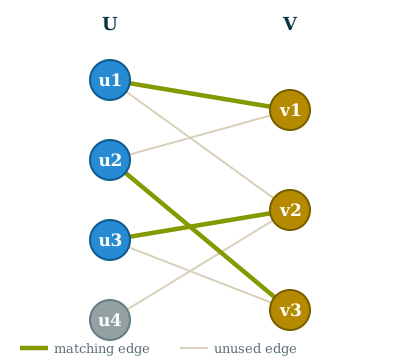
A maximum matching is a matching with at least as many edges as any other matching in the graph. A perfect matching is a matching where every vertex has a matched vertex.
Bipartite Matching
Food Preparation as a Graph
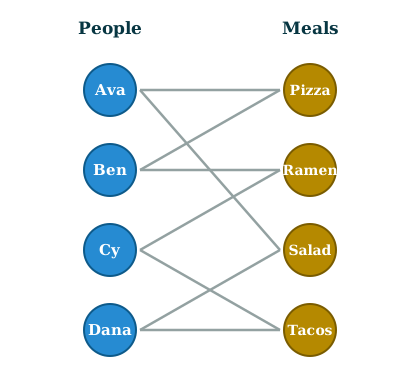
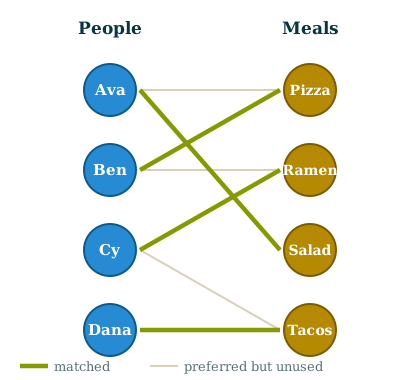
Put the people on one side and the meals on the other.
Join a person to a meal by an edge whenever that person would be happy with that meal.
This is a bipartite graph: every edge goes from a person to a meal, never person-to-person or meal-to-meal.
Bipartite Matching
A Matching
A matching is a set of edges, no two of which share an endpoint: each person gets at most one meal, and each meal goes to at most one person.
Giving everyone a meal they want means finding a matching that covers all $N$ people, called a perfect matching.
The green edges are one perfect matching: Ava–Salad, Ben–Pizza, Cy–Ramen, Dana–Tacos.
Bipartite Matching
An ILP Formulation
How can we model maximum bipartite matching as an integer program?
Bipartite Matching
Decision variables
What should the variables be?
For each edge, we need to decide whether it is part of the matching or not.
For each edge $\{i,j\}$, introduce a variable $x_{ij}$ that is 1 if that edge is in the matching and 0 otherwise.
Bipartite Matching
Constraints
Variables correspond to edges, constraints correspond to vertices.
For every vertex, there can be at most one incident edge. For each $i \in V$, \[ \sum_{j : \{i,j\} \in E}x_{ij} \le 1. \]
Bipartite Matching
Objective
We want as many edges in the matching as possible.
To count the number of edges in the matching, sum up the indicator variables. \[ \max \sum_{\{i,j\} \in E}x_{ij} \]
Bipartite Matching
Assembling
| max | $\sum_{\{i,j\} \in E}x_{ij}$ | |
| such that | $\sum_{j : \{i,j\} \in E}x_{ij} \le 1$ | for each $i \in V$ |
| $0 \le x_{ij} \le 1$ | ||
| $x_{ij} \in \Z$ |
It turns out that the integrality constraints are not necessary! Matching can be solved with an LP.
Bipartite Matching
Scheduling Chefs
A restaurant needs to build next week's schedule for its chefs.
There are $m$ chefs and $n$ shifts during the week.
Each chef $i$ must be assigned to exactly $d_i$ shifts, and each shift must have exactly one chef working it.
Each chef also has time conflicts: some shifts they simply cannot work.
How can we model this as a matching problem?
Bipartite Matching
Handling the Conflicts
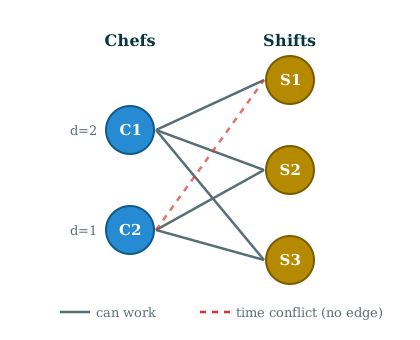
Put the chefs on one side and the shifts on the other, forming a bipartite graph.
Join chef $i$ to shift $j$ by an edge only when chef $i$ can work shift $j$.
Does a matching in this graph correspond to a valid schedule? No! Each chef must work multiple shifts.
Bipartite Matching
Making Copies
A plain matching would give each chef only one shift. But chef $i$ works $d_i$ shifts.
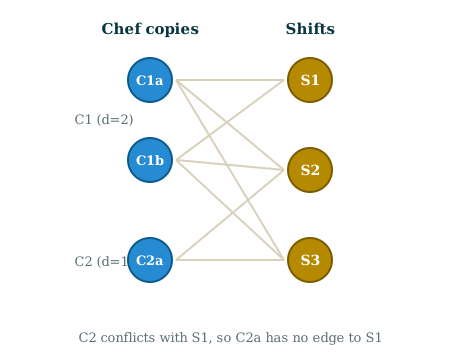
So make $d_i$ copies of each chef $i$.
Join a copy of chef $i$ to shift $j$ exactly when chef $i$ can work shift $j$ (respecting the conflicts).
Bipartite Matching
Making Copies
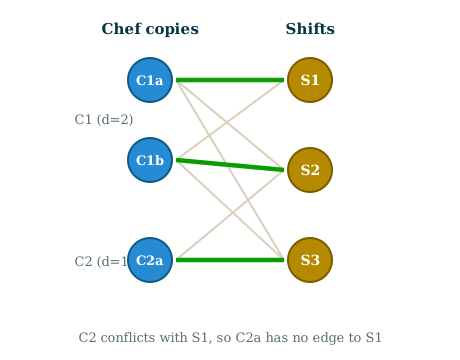
A perfect matching on this graph gives a valid schedule: each chef copy takes one shift, so chef $i$ works exactly $d_i$ shifts, and each shift is matched to exactly one chef.
Bipartite Matching
Making Copies
A perfect matching on this graph gives a valid schedule: each chef copy takes one shift, so chef $i$ works exactly $d_i$ shifts, and each shift is matched to exactly one chef.
Bipartite Matching
What if each shift requires multiple chefs?
The duplicating trick does not work; 2 copies of the same chef might be assigned to the same shift, which would not be physical.
If there are multiplicities in both the shift numbers, then we can model this as a flow problem. We'll see what those are later.
Bipartite Matching
More Examples
Let us look at a few small bipartite graphs and their maximum matchings.
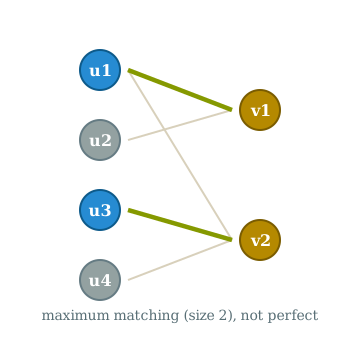
In each picture the green edges form a matching, and a grey vertex is one left unmatched.
Bipartite Matching
A Perfect Matching
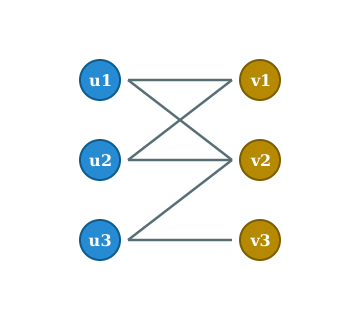
Here both sides have three vertices. Can we match all of them?
Bipartite Matching
A Perfect Matching
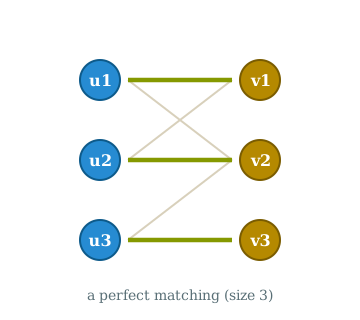
Here both sides have three vertices, and we can match all of them.
Every vertex is covered, so this matching is perfect. A perfect matching is always a maximum matching.
Bipartite Matching
Maximum but Not Perfect
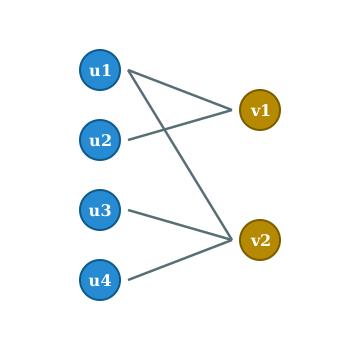
Now the left side has four vertices but the right side has only two.
A matching can use at most two edges, since each of the two right vertices takes at most one.
Bipartite Matching
Maximum but Not Perfect
Now the left side has four vertices but the right side has only two.
A matching can use at most two edges, since each of the two right vertices takes at most one.
So the matching shown is maximum (size $2$), but it cannot be perfect: two left vertices stay unmatched.
Bipartite Matching
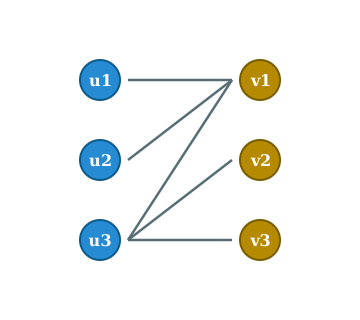
When No Perfect Matching Exists
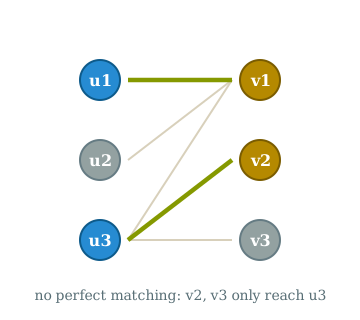
Here both $v_2$ and $v_3$ are only adjacent to $u_3$.
A single vertex $u_3$ cannot be matched to two partners, so no matching can cover both $v_2$ and $v_3$.
Bipartite Matching
When No Perfect Matching Exists
Here both $v_2$ and $v_3$ are only adjacent to $u_3$.
A single vertex $u_3$ cannot be matched to two partners, so no matching can cover both $v_2$ and $v_3$.
The best we can do has size $2$, leaving one right vertex unmatched: there is no perfect matching.