Introduction to Optimization
CO 250
Lecture 12
Lecture Outline
- Geometry of Polytopes
- Convexity and Extreme Points
- Duality Theory
Geometry of Polytopes
Half-Spaces
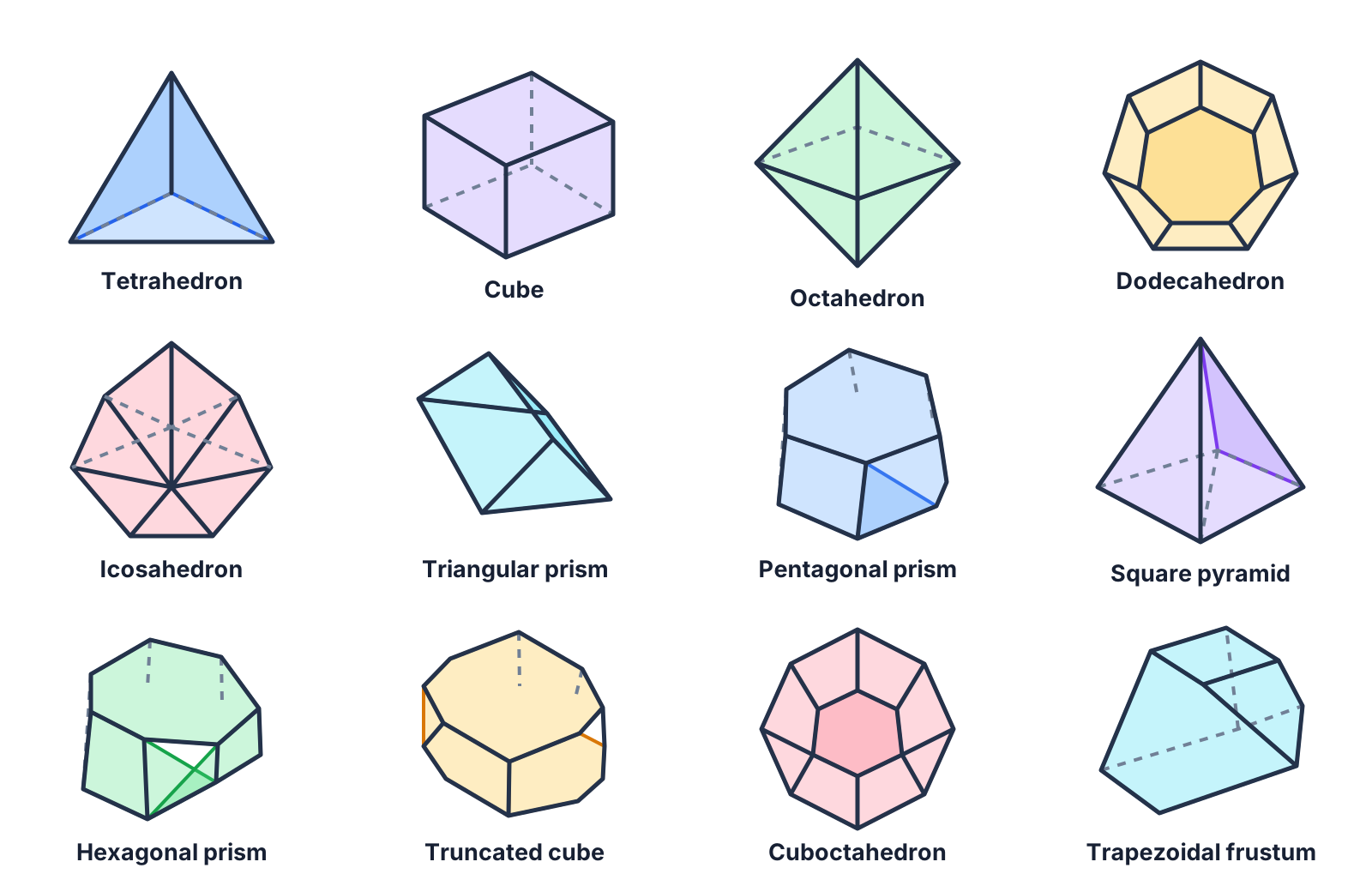
Every polytope is built out of inequalities of the form $a^{\intercal}x \le b$, each of which defines a half-space.
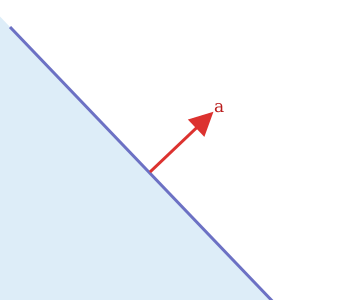
Half-Spaces
A half-space has the property of being convex.
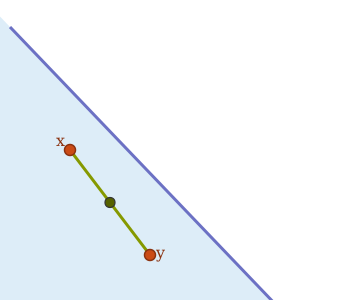
A set of points $S \subseteq \R^n$ is convex when the line segment joining any two points in the set is contained in the set.
Algebraically, this means the set is closed under taking averages: if $x,y \in S$ and $t \in [0,1]$, then
\[tx + (1-t)y \in S.\]
Half-Spaces
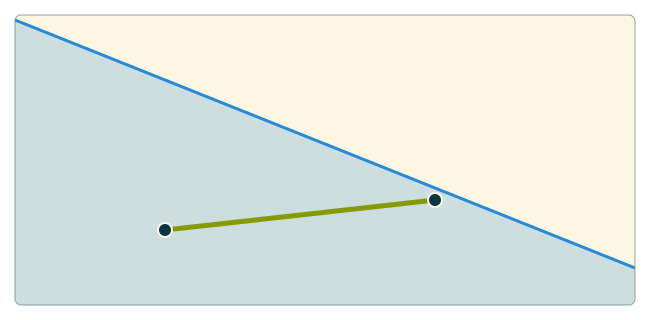
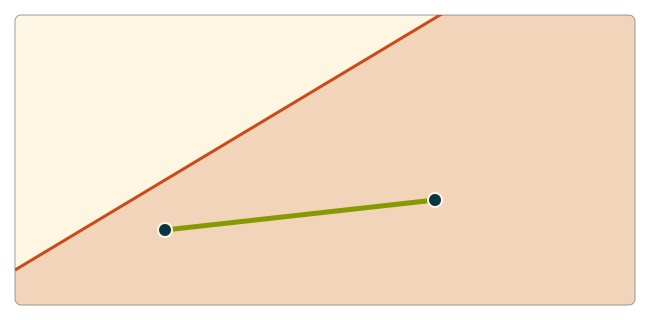
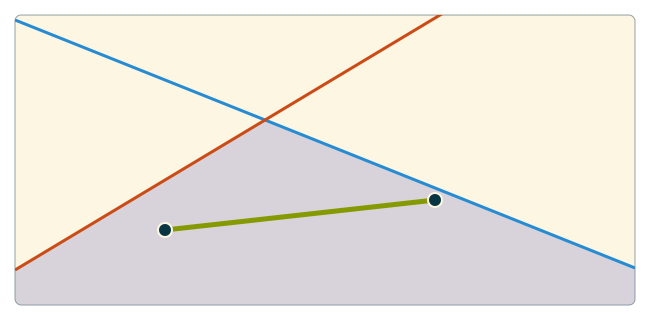
If two sets $S,T \subseteq \R^n$ are convex, then their intersection $S \cap T$ is also convex.
Half-Spaces
The feasible region for an LP is an intersection of halfspaces.
Intersections of convex sets are still convex, so every feasible region of an LP is convex.
Dimensions of Polytopes
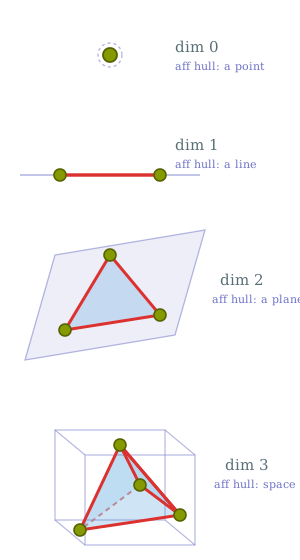
For a nonempty polytope defined by $P = \{x \in \R^n : Ax \le b\}$, where $A$ has rows $a_1, \dots, a_m$, we will let the set of implicit equations be $S = \{i : \forall x \in P, a_i^{\intercal}x = b_i\}$.
The affine hull is defined as $\{x \in \R^n : \forall i \in S, a_i^{\intercal}x = b_i\}$.*
The dimension of the polytope is defined to be the dimension of this affine hull, which is $n$ minus the rank of the matrix whose rows are the normals of the implicit equations.
* This is not the most general definition of the affine hull.Dimensions of Polytopes
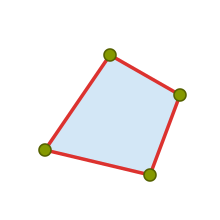
What are the dimensions of the following polytopes?
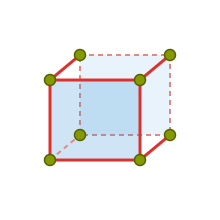
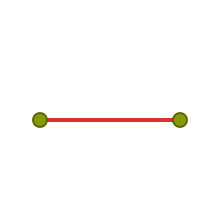
Faces of Polytopes
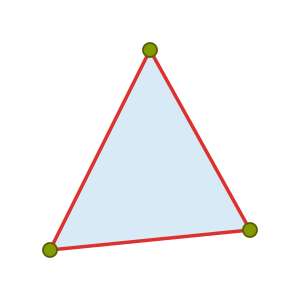
The faces consist of the 3 red edges, the 3 green vertices and the whole triangle (blue).
Let $P$ be a polytope $\{x \in \R^n : Ax \le b\}$. For a set $S \subseteq [m]$, the associated face of $P$ is the set of points where the associated inequalities are met with equality. \[ F = \{x \in \R^n : Ax \le b, \text{ and }\forall i \in S, a_i^{\intercal}x = b_i \}. \]
Each face is a polytope with its own dimension.
Faces of Polytopes
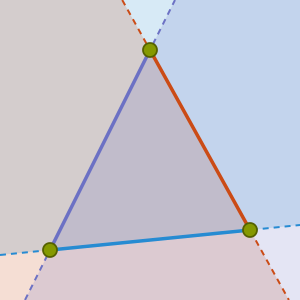
Zero dimensional faces are especially important; they are called vertices
A vertex in a polytope is a point where $n$ linearly independent inequalities hold with equality, where $n$ is the dimension of the ambient space.
Faces of Polytopes
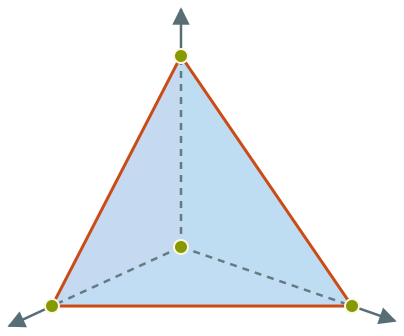
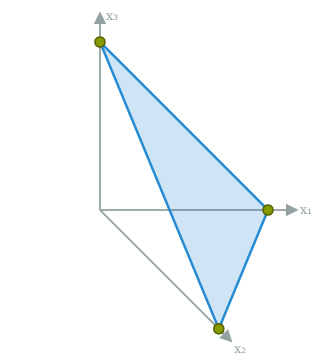
If we take $P = \{x \in \R^3 : x_1+x_2+x_3 \le 1, x_1, x_2, x_3 \ge 0\},$ then a vertex is a point where 3 of these inequalities are met with equality.
| Vertex | Tight inequalities (as equations) |
|---|---|
| $(0,0,0)$ | $x_1=0,\ x_2=0,\ x_3=0$ |
| $(1,0,0)$ | $x_1+x_2+x_3=1,$ $x_2=0,\ x_3=0$ |
| $(0,1,0)$ | $x_1+x_2+x_3=1,$ $x_1=0,\ x_3=0$ |
| $(0,0,1)$ | $x_1+x_2+x_3=1,$ $x_1=0,\ x_2=0$ |
Faces of Polytopes
Example: Cube
The cube is $\left\{x \in \R^3 : \begin{aligned} 0 &\le x_1 \le 1\\ 0 &\le x_2 \le 1\\ 0 &\le x_3 \le 1 \end{aligned}\right\}$.
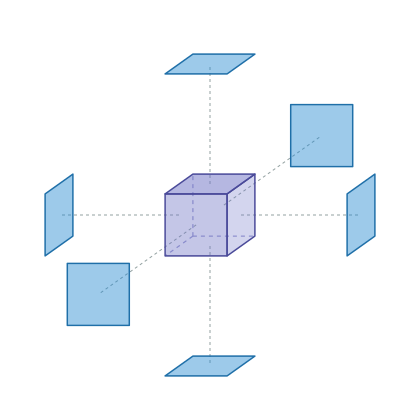
What are the 2 dimensional faces of the cube?
There are 6 faces that are 2-dimensional (one for each inequality in its description). In a polytope, faces of dimension $\dim(P)-1$ are called facets, and they correspond to nonredundant constraints in the inequality description.
Faces of Polytopes
Example: Cube
The cube is $\left\{x \in \R^3 : \begin{aligned} 0 &\le x_1 \le 1\\ 0 &\le x_2 \le 1\\ 0 &\le x_3 \le 1 \end{aligned}\right\}$.
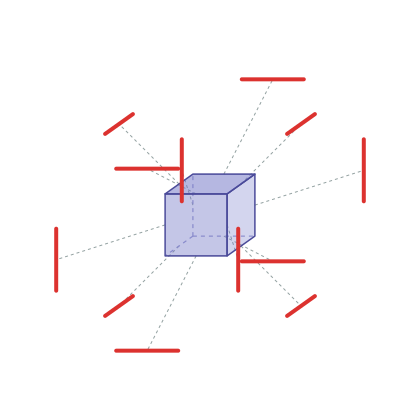
What are the 1 dimensional faces of the cube?
There are 12 edges in the cube (each facet has 4 edges, and each edge is on 2 faces for a total of $\frac{4 \times 6}{2} = 12$ ).
Faces of Polytopes
Example: Cube
The cube is $\left\{x \in \R^3 : \begin{aligned} 0 &\le x_1 \le 1\\ 0 &\le x_2 \le 1\\ 0 &\le x_3 \le 1 \end{aligned}\right\}$.
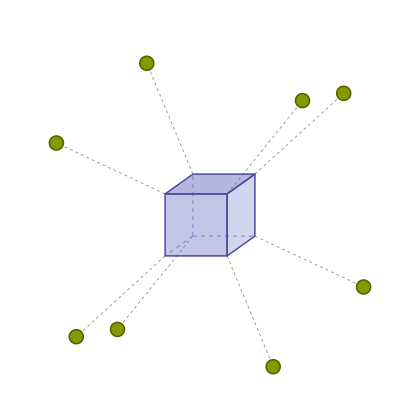
What are the 0 dimensional faces of the cube?
There are 8 vertices of the cube. We can count this as each vertex corresponds to setting 3 of the inequalities to equations. Each such equation specifies that $x_i = 0$ or $x_i = 1$; there are 8 ways to choose one of these choices for each coordinate.
Faces of Polytopes
What do vertices correspond to for a polytope of the form $P = \left\{x \in \R^n : \begin{aligned} Ax &= b\\ x &\ge 0 \end{aligned}\right\}$?
Let's assume that $A \in \R^{m \times n}$ has full row rank. This gives $m$ independent equations; how many additional independent tight constraints are needed to find a vertex?
Thus, the vertices should correspond to points in $P$ where $n-m$ of the inequalities $x_i \ge 0$, together with $Ax=b$, give $n$ independent tight constraints. These are points where at least $n-m$ entries are 0.
These are exactly the basic feasible solutions!
Vertices are Extreme Points
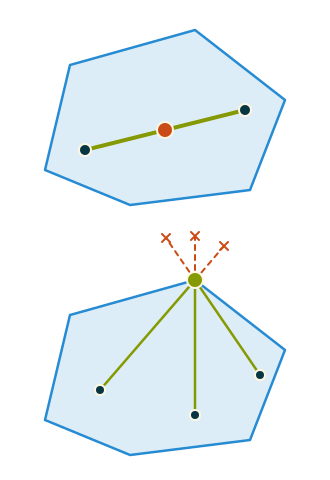
An extreme point of a set $S \subseteq \R^n$ is a point in $S$ not contained in the interior of any line segment joining two points in $S$.
Algebraically, $x \in S$ is an extreme point if for any $y, z \in S$ so that $x \neq y, z$, and any $t \in (0,1)$, \[ x \neq t y + (1-t)z \]
Theorem
A point in a polytope $P = \{x \in \R^n : Ax \le b\}$ is an extreme point if and only if that point is a vertex, i.e. there are $n$ linearly independent rows of $A$ so that $x$ meets those inequalities with equality.
Vertices are Extreme Points
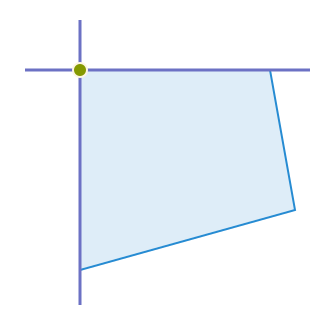
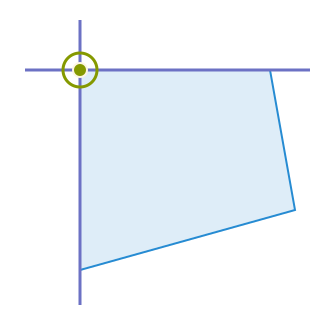
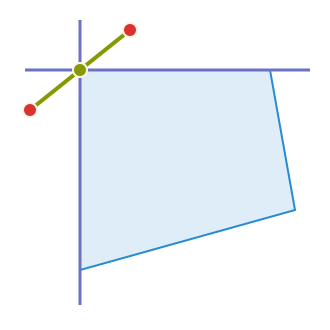
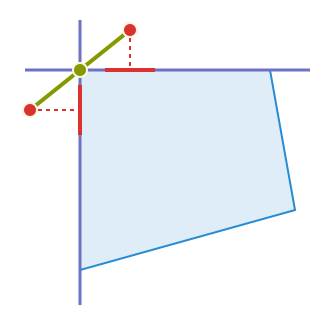
Proof of the Theorem: Let $x \in P$ be a vertex, so that $a_1^{\intercal}x = b_1, \dots, a_n^{\intercal}x = b_n$ where $a_1, \dots, a_n$ are linearly independent.
We can write this as a square system $A^= x = b^=$, so $x = (A^=)^{-1}b^=$ is the unique solution to this system.
If $x = t y + (1-t)z$, where $y, z \in P$ and $0<t<1$, then \[ b_i = a_i^{\intercal}x = t(a_i^{\intercal} y) + (1-t)(a_i^{\intercal}z). \]
Both $a_i^{\intercal}y$ and $a_i^{\intercal}z \le b_i$, so the only way they can average to $b_i$ is if they are both equal to $b_i$! Therefore, $a_i^{\intercal}y = a_i^{\intercal}z = b_i$ for each $i$, so that $A^= y = A^= z = b^=.$ Therefore, $y = z = x$.
Vertices are Extreme Points
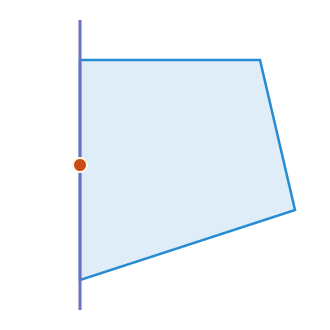
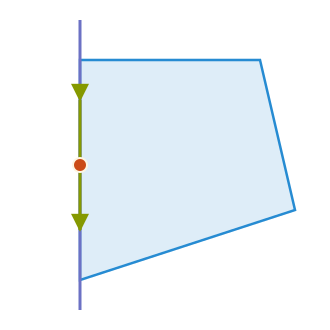
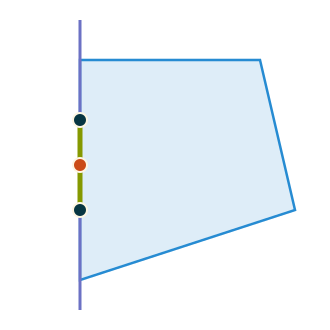
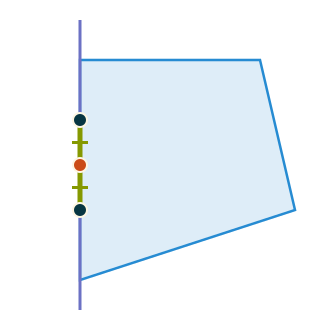
Proof of the converse: We show that if $x\in P$ is not a vertex, then it is not extreme. There may be tight inequalities at $x$, say $a_1^{\intercal}x = b_1, \dots, a_k^{\intercal}x = b_k$. The span of $a_1, \dots, a_k$ is not all of $\R^n$.
There must be some $v \neq 0$ so that $a_i^{\intercal}v = 0$ for each $i=1,\dots,k$. $a_i^{\intercal}(x + tv) = b_i$ for all $i=1,\dots,k$.
Every other inequality has slack: $a_i^{\intercal}x<b_i$ for $i > k$. We can choose $\varepsilon>0$ small enough that both $x+\varepsilon v$ and $x-\varepsilon v$ are still in $P$.
These points are distinct, and $x$ is their midpoint, so $x$ is not extreme: \[x=\tfrac12(x+\varepsilon v)+\tfrac12(x-\varepsilon v).\]
Linear Optimization and Vertices
Extreme points of sets are important because they are often the maximizers of linear functions on $S$.
Theorem
If a linear function $c^{\intercal}x$ has a unique maximum on a set $S \subseteq \R^n$, then that maximizer is an extreme point of $S$.
Proof: Let $x^*$ be the maximizer and suppose that $x^*$ is not an extreme point, so there are $y, z \in S$ with $y,z \neq x^*$ and $\lambda \in (0,1)$ so that $x^* = \lambda y + (1-\lambda)z$.
Well, then $c^{\intercal}x^* = \lambda c^{\intercal}y + (1-\lambda)c^{\intercal}z$, and since $x^*$ was the unique maximizer, $c^{\intercal}y, c^{\intercal}z < c^{\intercal}x^*$, and we get the contradiction that $c^{\intercal}x^* < c^{\intercal}x^*$.
If $S$ is nonempty, compact, and convex, then any linear function is maximized at an extreme point of $S$.
Linear Optimization and Vertices
It is not always true that a bounded linear function on a polytope has an extreme point as a maximizer; for example, consider maximizing $x_1+x_2+x_3$ subject to the constraint that $x_1+x_2+x_3=0$. Every point on this hyperplane is a maximizer, but it has no extreme points.
For the feasible set of an LP in standard equality form, though, something stronger holds.
Theorem
If $P = \{x \in \R^n : Ax = b, x\ge 0\}$ is a nonempty polytope, and $c^{\intercal}x$ is a linear function that is bounded from above on $P$, then there is a maximizer that is an extreme point.
Geometry and Duality
The most important theorem in convex geometry.
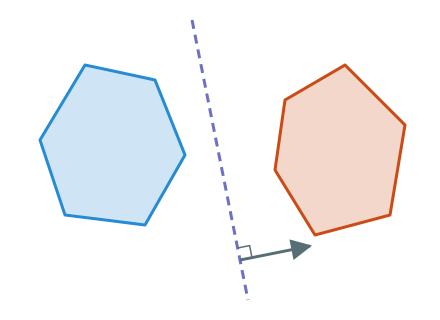
Separating Hyperplane Theorem
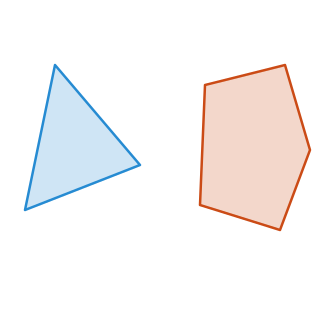
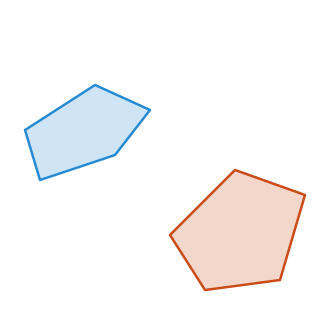
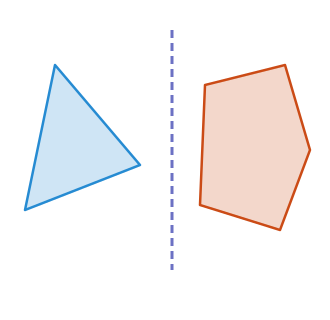
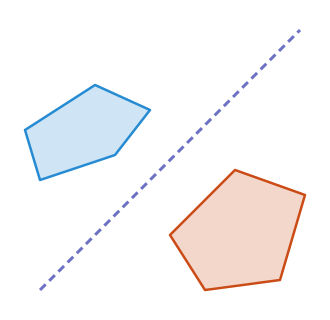
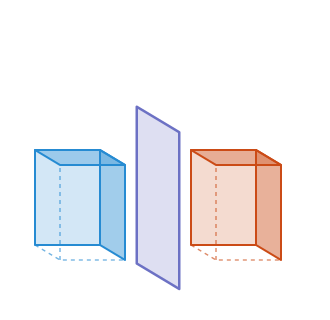
If $P$ and $Q$ are two convex polytopes in $\R^n$, and $P \cap Q = \varnothing$, then there exists some $z$ so that $z^{\intercal}p < z^{\intercal}q$ for any $p \in P$ and $q \in Q$.
Disjoint Polytopes
Separating Hyperplanes
Geometry and Duality
We can use the separating hyperplane theorem to prove the following result, which essentially shows that any infeasible LP has a certificate of infeasibility.
Farkas' Lemma
The set $\{x\in \R^n : Ax = b, x \ge 0\}$ is empty if and only if there exists some $y$ so that $A^{\intercal}y \ge 0$ and $b^{\intercal}y < 0$.
Farkas' Lemma: Proof
Suppose $\{x:Ax=b,\ x\ge0\}$ is empty. Let \[P=\{x\in\R^n:Ax=b\},\qquad Q=\{x\in\R^n:x\ge0\}.\] These are disjoint polytopes: equations can be written as pairs of inequalities.
First, what if $P$ is empty? Then $b$ is not in the column space of $A$. By linear algebra, there is a vector $y$ orthogonal to every column of $A$ but not to $b$.
Scale $y$ so that $b^{\intercal}y=-1$. Then \[A^{\intercal}y=0\ge0,\qquad b^{\intercal}y=-1<0,\] giving the required certificate.
Farkas' Lemma: Proof
\[P=\{x\in\R^n:Ax=b\},\qquad Q=\{x\in\R^n:x\ge0\}.\]
Now suppose $P$ is nonempty. Separation gives $z\in\R^n$ such that \[z^{\intercal}q<z^{\intercal}p\qquad\text{for every }q\in Q,\ p\in P.\]
We claim that $z\le0$. If $z_i > 0$ for some $i$, then since the vector $te_i$ which is 0 in every entry, except for a $t\ge0$ in entry $i$, is in $Q$, $z^{\intercal}(te_i) = t z_i < z^{\intercal}p$ for any $p \in P$, but this fails for $t$ large enough.
Farkas' Lemma: Proof
\[P=\{x\in\R^n:Ax=b\},\qquad Q=\{x\in\R^n:x\ge0\}, z^{\intercal} q < z^{\intercal}p.\]
We now claim that $z = -A^{\intercal}y$ for some $y \in \R^m$.
To see this, we will show that $z^{\intercal}v = 0$ whenever $v$ is in the kernel of $A$. By linear algebra facts, this implies that $z$ will be in the row span of $A$.
Suppose that $z^{\intercal}v \neq 0$ for some $v \in \ker(A)$. By replacing $v$ by $-v$ if necessary, we can assume that $z^{\intercal}v < 0$. If we let $p \in P$, then $p + tv \in P$ for all $t > 0$, and so we would again arrive at a contradiction of the fact that $z^{\intercal}p > z^{\intercal}q$.
Farkas' Lemma: Proof
\[P=\{x\in\R^n:Ax=b\},\qquad Q=\{x\in\R^n:x\ge0\}, z^{\intercal} q < z^{\intercal}p.\]
We have seen that $z \le 0$ and $z = -A^{\intercal}y$ for some $y$, and so we have that $A^{\intercal}y \ge 0$.
To show that $y$ is a valid certificate of infeasibility, it remains to show that $b^{\intercal}y < 0$.
To see this, let $x_0$ be such that $Ax_0 = b$, and note that $-z^{\intercal}x_0 = y^{\intercal}Ax_0 = y^{\intercal}b$, and that $-z^{\intercal}x_0 < -z^{\intercal}0 = 0$, since $0 \in Q$.
Conversely, if $Ax=b$, $x\ge0$, and such a $y$ exists, then $0>b^{\intercal}y=x^{\intercal}A^{\intercal}y\ge0$, a contradiction. This concludes the proof.
Proof Sketch for Separating Hyperplane Theorem
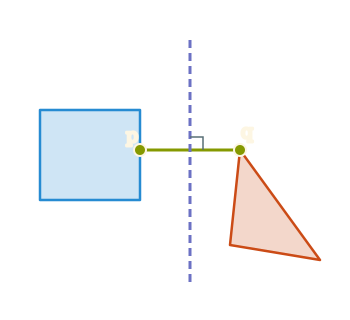
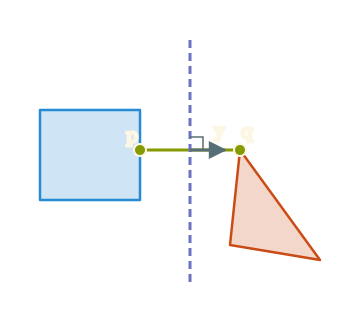
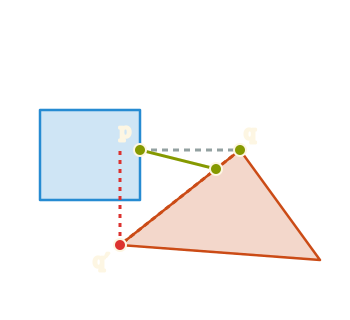
Let $p$ and $q$ be two points that minimize the value of $\min_{p \in P, q \in Q} \|p-q\|.^*$
We claim that $y = q - p$ is a normal vector for a separating hyperplane between $P$ and $Q$.
Suppose that there were some $p', q'$ so that $y^{\intercal}p' \ge y^{\intercal}q'$, then we could find another pair of points with smaller distance.
$*$ Showing such a pair exists requires some work.