Introduction to Optimization
CO 250
Lecture 5
Lecture Outline
- Linear Programming Review
- Outcomes of Linear Programs
Linear Programming
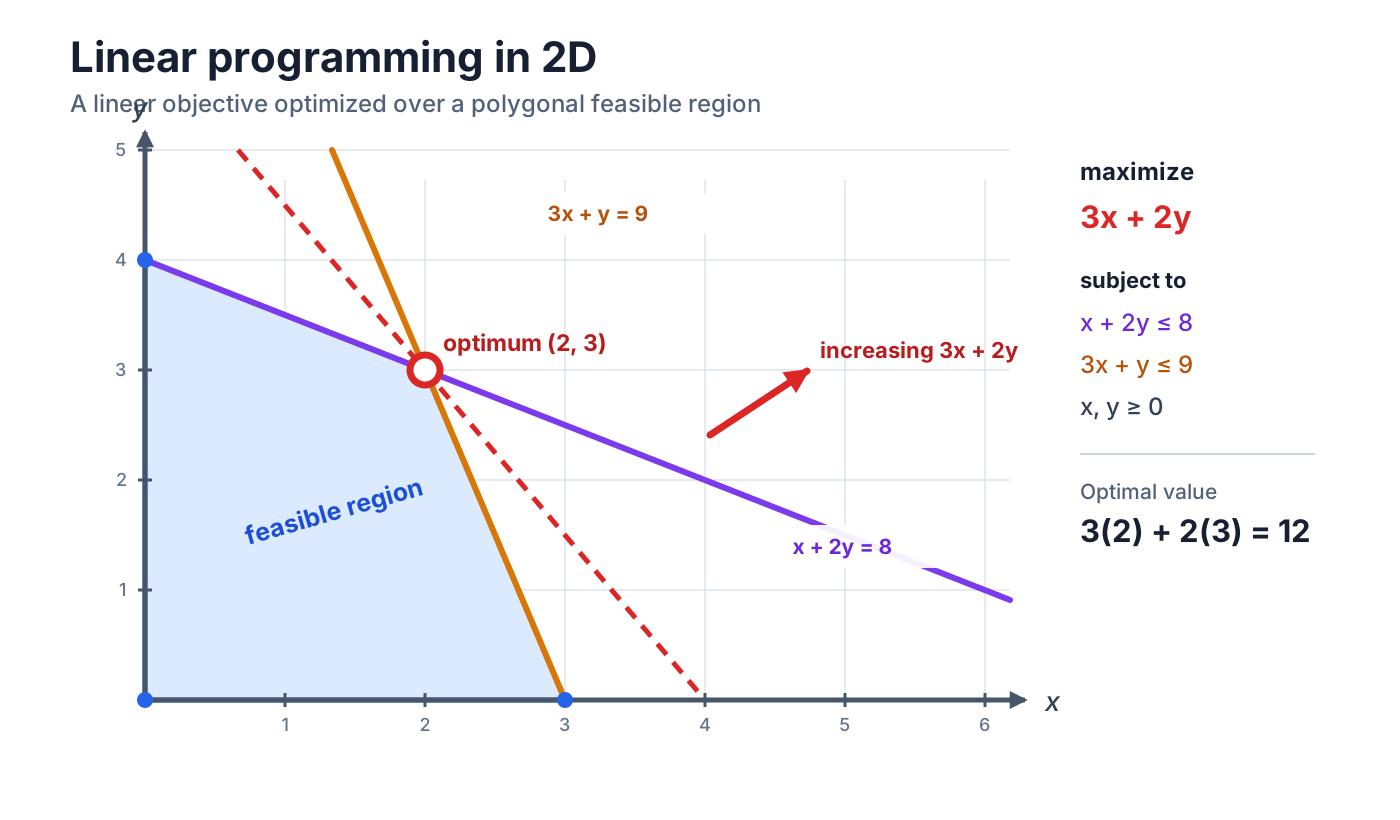
A linear program (LP) is an optimization problem whose objective is a linear function and whose feasible set is the set of solutions to some linear inequality.
| min | $c^{\intercal} x$ |
| such that | $Ax \le b$ |
Linear Programs
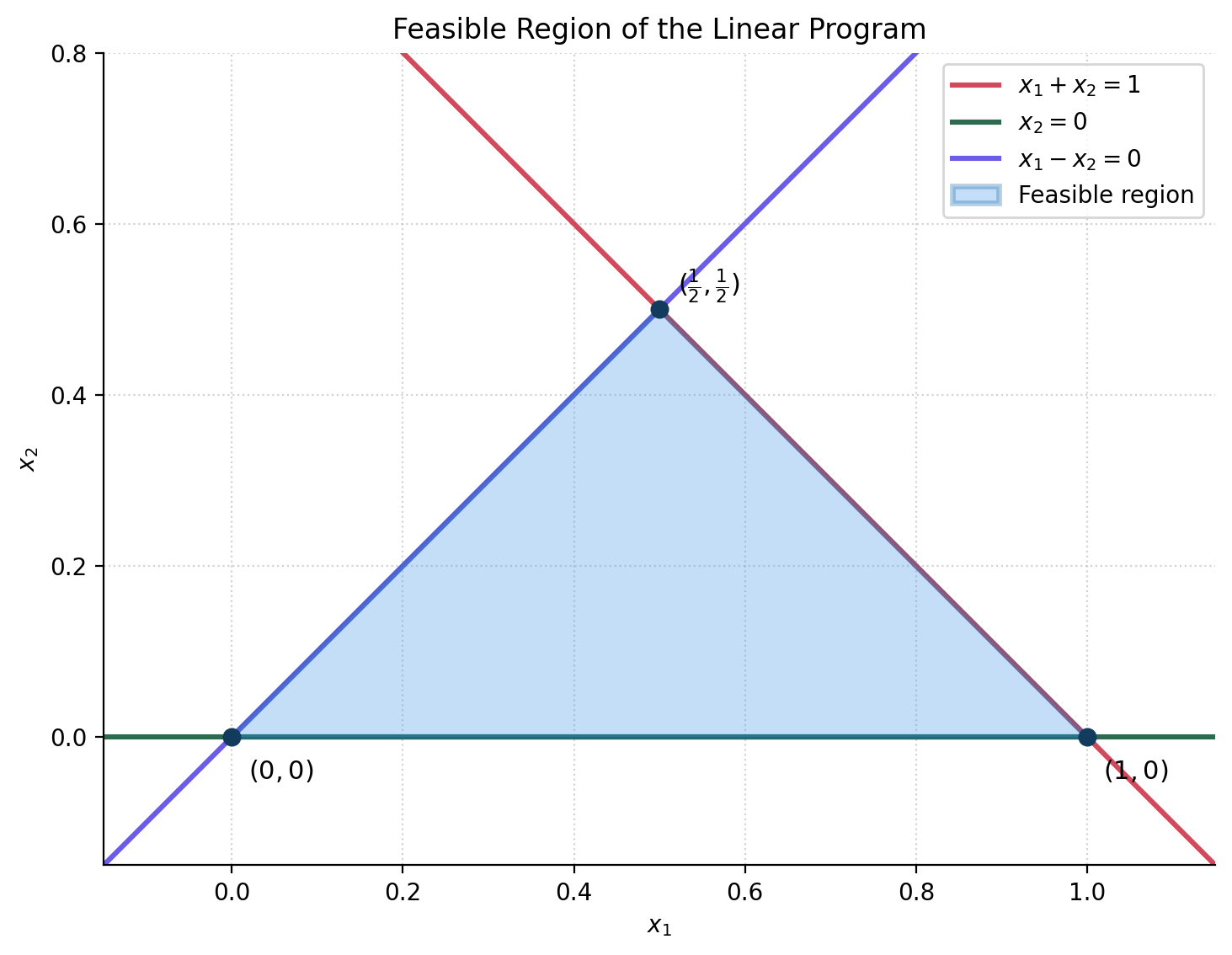
The following is an LP
| max | $x_2$ |
| such that | $ x_1 + x_2 \le 1$ |
| $x_1 - x_2 \ge 0$ | |
| $x_2 \ge 0.$ |
Linear Programs
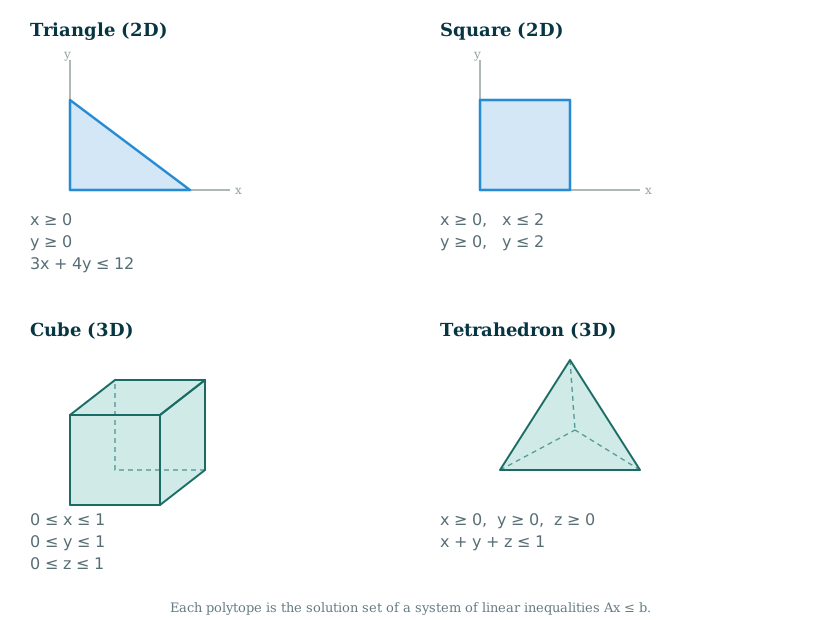
Feasible regions for linear programs are polytopes.
Linear Programming Feasibility
A point $x \in \R^n$ is feasible if $Ax \le b$.
A linear program is said to be feasible if it has some feasible point.
Some linear programs are infeasible: for example,
| min | $x_1$ |
| such that | $x_1 \le 1$ |
| $x_1 \ge 2$ |
No point can satisfy both $x_1 \le 1$ and $x_1 \ge 2$, so there are no feasible points.
Linear Programming Optimal Solutions
$x$ is optimal for a linear program if
- it is feasible, and
- for any feasible $y$, the objective satisfies $c^{\intercal}x \le c^{\intercal}y$
(where we use the min convention for the objective).
A linear program can be feasible and have no optimal point.
For example,
| min | $x_1$ |
| such that | $x_1 \le 0$ |
This is feasible (e.g. $x_1 = 0$), but for any feasible $x_1$ the point $x_1 - 1$ is also feasible and has a smaller objective. So no feasible point is optimal.
Linear Programming Unboundedness
A linear program is said to be unbounded if there are feasible points with arbitrarily small objective values.
The example from the previous slide is unbounded:
| min | $x_1$ |
| such that | $x_1 \le 0$ |
Note the use of the phrase `arbitrarily small', as opposed to infinitely small. Any feasible point has finite objective value, but there is no lower bound for those objective values in some cases.
Linear Programming Unboundedness
A more general nonlinear program can be feasible and bounded, but still have no optimal point.
| min | $x$ |
| such that | $xy \ge 1$ |
| $x, y \ge 0$ |
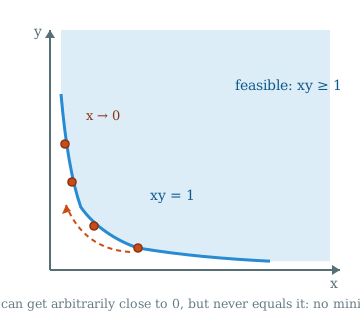
Linear programs are special! This kind of example cannot exist with linear programs.
Possible Outcomes for Linear Programs
Trichotomy theorem
Every linear program satisfies exactly one of the following:- It is infeasible.
- It has an optimal point.
- It is unbounded.
Possible Outcomes for Linear Programs
Possible Outcomes for Linear Programs
Examples of each case.
|
An infeasible problem
No point satisfies both bounds. |
A problem with an optimal point
The optimum is $x_1 = 0$. |
An unbounded problem
The objective can be made arbitrarily small. |
Checking Unboundedness
A linear program is unbounded if it has feasible points whose objective values become arbitrarily small. How can we check that this is the case?
We can solve another LP!
Checking Unboundedness
A recession direction (also, a certificate of unboundedness) for the LP
| min | $c^{\intercal} x$ |
| such that | $Ax \le b$ |
is a vector $v$ so that \[Av \le 0 \text{ and }\] \[c^{\intercal} v = -1.\]
Theorem
A linear program is unbounded if and only if it is feasible and it has a recession direction.Checking Unboundedness
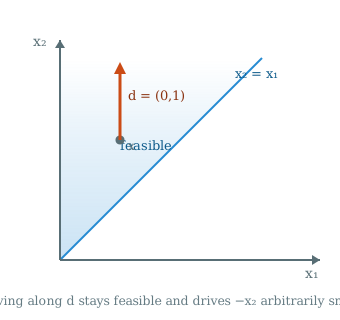
Example of a Recession Direction
| min | $-x_2$ |
| such that | $-x_1 \le 0$ |
| $x_1 - x_2 \le 0$ |
The direction $d = (0, 1)$ is a recession direction: $Ad \le 0$ and $c^{\intercal} d = -1$.
Starting from any feasible $x$, the points $x + td$ stay feasible for all $t \ge 0$, and the objective $-x_2$ decreases without bound. So the LP is unbounded.
Checking Unboundedness
Proof of unboundedness theorem (one direction)
Suppose there is a recession direction $v$, and that the LP has a feasible $x$, and consider $x+tv$ for $t \ge 0$.
Claim 1: $x+tv$ is feasible.
$A(x+tv) = Ax + t Av$, and since $Av \le 0$, we have that $Ax + tAv \le Ax \le b$, so $x+tv$ if feasible.
Claim 2: The LP is unbounded.
$c^{\intercal}(x+tv) = c^{\intercal}x + t c^{\intercal} v = c^{\intercal}x - t$, so by making $t$ large, this can be arbitrarily small.
Checking Unboundedness
Proof of unboundedness theorem (other direction)
Given a sequence $x_1, \dots, $ of feasible points with unbounded objective, want to produce a recession direction. This requires some analysis.
See the textbook for details.
Possible Outcomes for Linear Programs
Trichotomy theorem
Every linear program satisfies exactly one of the following:- It is infeasible.
- It has an optimal point.
- It is unbounded.
We can prove feasibility by writing down a feasible point satisfying $Ax \le b$, and we can prove unboundedness by writing down a recession direction.
How do we prove infeasibility?
Proving Infeasibility
Example: Bipartite Matching
The following is a bipartite perfect matching LP.
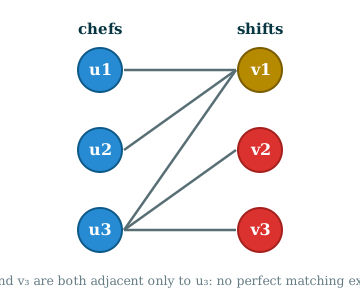
| $x_{11}$ | $= 1$ | ($u_1$) |
| $x_{21}$ | $= 1$ | ($u_2$) |
| $x_{31} + x_{32} + x_{33}$ | $= 1$ | ($u_3$) |
| $x_{11} + x_{21} + x_{31}$ | $= 1$ | ($v_1$) |
| $x_{32}$ | $= 1$ | ($v_2$) |
| $x_{33}$ | $= 1$ | ($v_3$) |
| $x_{11}, x_{21}, x_{31}, x_{32}, x_{33} \ge 0$ |
How can we prove this is infeasible?
Proving Infeasibility
Example: Bipartite Matching
The following is a bipartite perfect matching LP.
Look at the following inequalities
| $x_{11}$ | $= 1$ | ($u_1$) |
| $x_{21}$ | $= 1$ | ($u_2$) |
| $x_{31}$ | $\ge 0$ | |
| $x_{11} + x_{21} + x_{31}$ | $= 1$ | ($v_1$) |
Let's combine these inequalities as follows: add these inequalities with weights $(1,1,1,-1)$.
Proving Infeasibility
Example: Bipartite Matching
The following is a bipartite perfect matching LP.
Look at the following inequalities
| $(x_{11}$ | $= 1)$ | |
| + | $(x_{21}$ | $= 1)$ |
| + | $(x_{31}$ | $\ge 0)$ |
| - | $(x_{11} + x_{21} + x_{31}$ | $= 1)$ |
| = | $0$ | $\ge 1$ |
This is not a valid inequality!
Proving Infeasibility
To show infeasibility, we want to find a contradictory inequality, like $0 \ge 1$. How do we do this formally?
If we take the inequalities $Ax \le b$ and combine them with weights $y$, we get the inequality \[ y^{\intercal} A x \le y^{\intercal}b. \] as long as the weights are nonnegative, this is a valid inequality.
If the left side is 0 for all $x$, and the right side is negative, then this is a contradiction of the existence of $x$ satisfying these inequalities.
Proving Infeasibility
A certificate of infeasibility for the LP
| min | $c^{\intercal} x$ |
| such that | $Ax \le b$ |
is a vector $y \in \R^m$ so that $y \ge 0$ and \[ A^{\intercal}y = 0 \] \[ b^{\intercal}y < 0. \]
Theorem
A linear program is infeasible if and only if it has a certificate of infeasibility.
Proving Infeasibility
Example of a Certificate
Consider the infeasible system (in $Ax \le b$ form) \[ x_1 + x_2 \le -1, \qquad -2x_1 + x_2 \le -1, \qquad x_1 - 2x_2 \le -1, \] so $A = \begin{bmatrix} 1 & 1 \\ -2 & 1 \\ 1 & -2 \end{bmatrix}$ and $b = \begin{bmatrix} -1 \\ -1 \\ -1 \end{bmatrix}$.
Take $y = (1, 1, 1) \ge 0$. Then \[ A^{\intercal} y = (1 - 2 + 1,\ 1 + 1 - 2) = (0, 0), \qquad b^{\intercal} y = -3 < 0, \] so $y$ is a certificate of infeasibility.
Proving Optimality
Given LP
| min | $c^{\intercal} x$ |
| such that | $Ax \le b$ |
and a feasible point $x^*$, how can we show that this is optimal?
One approach: optimality is equivalent to the infeasibility of the following system of inequalities for all $\epsilon > 0$:
\[ \begin{pmatrix} A\\ c^{\intercal} \end{pmatrix} x \le \begin{pmatrix}b\\ c^{\intercal}x^* - \epsilon\end{pmatrix} \]Here, we use block matrix notation.
Proving Optimality
One approach: optimality is equivalent to the infeasibility of the following system of inequalities for all $\epsilon > 0$:
\[ \begin{pmatrix} A\\ c^{\intercal} \end{pmatrix} x \le \begin{pmatrix}b\\ c^{\intercal}x^* - \epsilon\end{pmatrix} \]
An infeasibility certificate for this is $\begin{pmatrix} y \\ y_0 \end{pmatrix}$ so that \[ A^{\intercal}y + c^{\intercal}y_0 = 0, \] \[ b^{\intercal}y + (c^{\intercal}x^* - \epsilon)y_0 < 0, \] and where $y, y_0 \ge 0$
Clearly, $y_0$ would need to be positive (otherwise the LP would be infeasible), and by scaling, we can make it equal to 1.
Proving Optimality
A certificate of optimality is some $y \ge 0$ so that \[ A^{\intercal}y = -c^{\intercal}, \] \[ b^{\intercal}y \le -c^{\intercal}x^*. \]
If such a thing exists, then our earlier work on infeasibility certificates implies that $x^*$ is optimal.
Proving Optimality
Example of a Certificate
Consider the LP
| min | $-x_1 - x_2$ |
| such that | $x_1 \le 1$ |
| $x_2 \le 1$ |
so $c = (-1,-1)$, $A = \begin{bmatrix} 1 & 0 \\ 0 & 1 \end{bmatrix}$, and $b = (1,1)$.
The point $x^* = (1, 1)$ is feasible with objective $-2$.
Take $y = (1, 1) \ge 0$. Then \[ A^{\intercal} y = (1, 1) = -c^{\intercal}, \qquad b^{\intercal} y = 2 = -c^{\intercal} x^*, \] so $y$ is a certificate of optimality: $x^*$ is optimal.
Proving Optimality
Trichotomy theorem
Every linear program satisfies exactly one of the following:- It is infeasible.
- It has an optimal point.
- It is unbounded.
If an LP is infeasible, we can prove this with a certificate of infeasibility.
If an LP has an optimal point, we can prove this by providing an optimal point, and also a certificate of optimality.
If an LP is unbounded, we can prove this by providing a feasible point, and a recession direction.
How can we find these things algorithmically?